10 SEO Tips to Improve Your Website Rankings in 2026

Quick Read Summary:
If you have a website but people are not finding it on Google, you may be wondering what you are doing wrong. Having a website is not enough. You also need SEO to help search engines understand your content and help people find your pages.
When I started learning about SEO, I understood that small things can make a big difference. Keyword research, headings, images, links, mobile experience, and website speed all work together.
In this blog, I will share 10 simple SEO tips that can help you improve website ranking in 2026. These tips are useful for beginners, small businesses, bloggers, and anyone who wants better visibility on Google.
The main idea is simple: write for people first and structure your content so Google can understand it.
1. Start With the Right Keyword
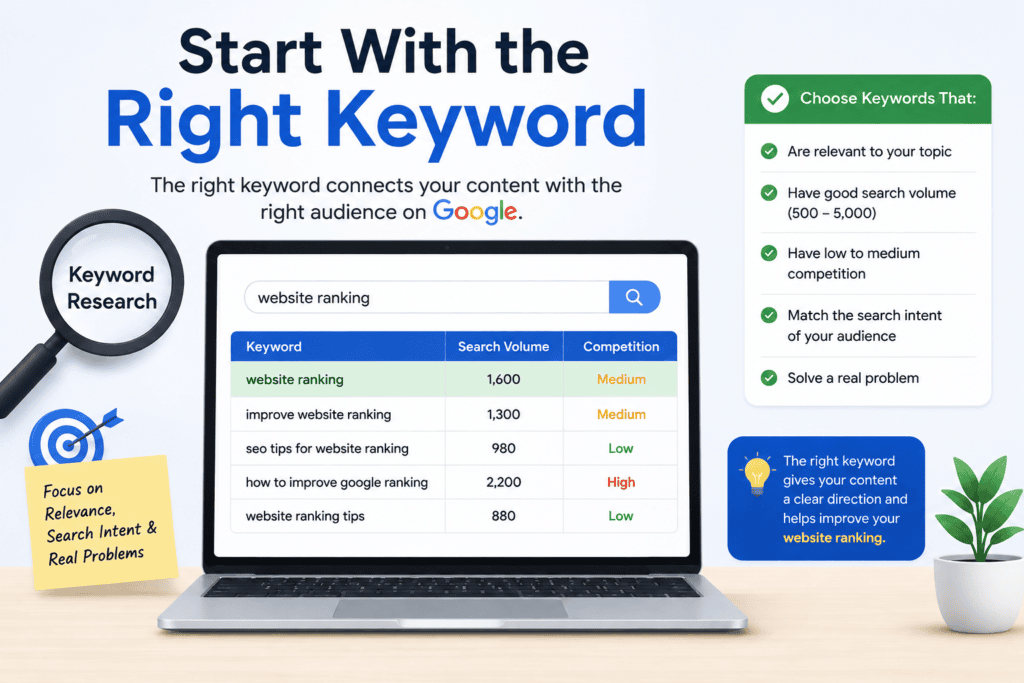
The first step to improving website ranking is keyword research.
Before writing a blog, think about what your audience is searching for on Google. A keyword should be related to your topic and should solve a real problem.
For example, “digital marketing” is a very broad keyword. “Digital marketing course in Delhi” is more specific and can target a particular audience.
When choosing keywords, look for:
- Relevance to your topic
- A clear search intent
- A real problem people want to solve
- Low to medium competition when possible
For this blog, the main focus keyword is website ranking.
Choosing the right keyword gives your content a clear direction and can support better website ranking.
2. Create Useful Content for People
One of the most important SEO tips is to create useful content.
Do not write a blog only because you want to put keywords in it. Your content should answer questions and give readers something useful.
I have learned during my SEO learning journey that simple explanations are much easier to understand than complicated words. When I break a topic into small sections, it becomes easier for me and the reader.
Before publishing a blog, ask yourself:
- Does this answer the reader’s question?
- Is the information easy to understand?
- Does it provide something useful?
- Would I find this helpful if I searched for this topic?
Useful content can support website ranking because it gives people a reason to read and explore your website.
3. Use Keywords Naturally
Keywords are important in SEO, but using them too many times can make your content difficult to read.
Your focus keyword should appear naturally in important areas such as the title, URL, meta description, introduction, headings, and image ALT text.
For this article, website ranking is the focus keyword. I am using it where it makes sense instead of forcing it into every sentence.
You can also use related terms such as SEO, SEO tips, Google ranking, and improve website ranking.
This makes your content more natural and helps you cover the topic properly.
Remember, good SEO is not about repeating one keyword again and again. It is about making useful content that matches what people are searching for.
4. Use Clear Headings
Clear headings make your blog easier to read.
Use one H1 for the main title. Use H2 headings for the main sections and H3 headings when you need smaller sections.
For example:
- H1: 10 SEO Tips to Improve Your Google Rankings in 2026
- H2: Start With the Right Keyword
- H2: Create Useful Content for People
- H2: Improve Your Website Speed
A good heading structure helps readers quickly find the information they want.
It also gives search engines a better understanding of your page.
If your content is well organized, users can move through the blog easily. This is an important part of creating content that supports website ranking.
5. Optimize Your SEO Title and Meta Description
Your SEO title is one of the first things people see in Google search results.
Your focus keyword should be included in the title, and the title should also tell the reader what they will learn.
For example:
“10 SEO Tips to Improve Website Ranking in 2026”
The title is simple and clearly explains the benefit.
You should also write a useful meta description. It should include your focus keyword naturally and give people a reason to click.
Small improvements in your title and description can make your search result clearer.
This is why SEO is not only about writing the main article. You also need to optimize the information that appears in search results.
6. Add Useful Images and ALT Text
Images can make a blog easier to understand and more interesting to read.
But images should also be optimized properly.
Give your image a meaningful file name instead of something like “IMG1234.jpg.”
For example:
website-ranking-seo-tips.jpg
You should also add descriptive ALT text.
For example:
SEO tips to improve website ranking
The image should also be compressed so that it does not slow down your website.
I personally find that adding an image after an important heading makes a long blog easier to scan, especially when reading on a phone.
Good image optimization can support SEO and improve the overall experience of your website.
7. Use Internal and External Links
Links are another useful part of SEO.
Internal links connect one page of your website to another relevant page. They can help readers discover more content and help search engines understand your website structure.
External links connect your content to trusted websites or sources.
For example, if you explain an SEO topic, you can link to Google Search Central for additional information.
Do not add links just to increase the number of links. Every link should have a purpose.
A good linking strategy can help users find more useful information and can support website ranking.
8. Make Your Website Mobile-Friendly
A large number of people use smartphones to search, read blogs, shop, and visit websites.
This means your website should work properly on mobile devices.
Check:
- Text size
- Button size
- Image size
- Page layout
- Navigation
- Loading time
If users cannot easily read or use your website on their phone, they may leave.
Good SEO is not only about keywords. The experience people get after visiting your website is also important.
A mobile-friendly website makes your content easier to access and can support better website ranking.
9. Improve Your Website Speed
Nobody likes waiting for a slow website.
Large images, unnecessary plugins, poor hosting, and too many website elements can make a page slow.
You can improve your website speed by:
- Compressing images
- Removing unnecessary plugins
- Using good hosting
- Keeping the design simple
- Checking your website regularly
A faster website gives users a better experience.
When you are working on website ranking, do not focus only on your content. Check the technical side of your website too.
Website speed becomes even more important when people are accessing your website through mobile internet.
10. Keep Updating Your Content
SEO is not something you do once and forget.
Search trends change. Information changes. Your competitors also create new content.
This is why you should check your old blogs regularly.
Look for:
- Outdated information
- Broken links
- Old examples
- Missing information
- Sections that can be explained better
I think this is one of the easiest SEO tips for beginners because you can start with content you already have.
Instead of always creating a completely new blog, you can improve useful old content and make it more helpful.
Regular updates can support website ranking when they genuinely improve the content for users.
How Long Does It Take to Improve Website Ranking?
SEO usually does not give instant results.
The time can depend on your website, competition, content quality, technical issues, and the keywords you are targeting.
So, do not expect your website to reach the top of Google immediately.
Instead, focus on consistent improvement.
Start with keyword research. Then improve your content, headings, images, links, mobile experience, and website speed.
When you follow these SEO tips consistently, you give your website a better foundation for long-term growth.
Common SEO Mistakes to Avoid
While working on website ranking, beginners can make some common mistakes.
Avoid:
- Keyword stuffing
- Copying content
- Using unclear headings
- Uploading very large images
- Ignoring mobile users
- Adding irrelevant links
- Writing only for search engines
- Expecting instant results
The goal of SEO is not to trick Google.
The goal is to create useful content and make your website easy for both users and search engines to understand.
Conclusion
Improving website ranking in 2026 is not about finding one secret trick.
It is a combination of keyword research, useful content, clear headings, optimized images, internal and external links, mobile-friendly design, good website speed, and regular content updates.
If you are a beginner, do not try to fix everything in one day. Start with one or two SEO tips and slowly improve your website.
The biggest thing I have learned while learning SEO is that consistency matters. You may not see results immediately, but you can keep learning, testing, and improving.
SEO is a skill, and you become better with practice.
Learn SEO and Digital Marketing With Vidya Sarthi
If you want to learn SEO, Google Ads, social media marketing, and other digital marketing skills, you can explore Vidya Sarthi’s digital marketing course.
Learning SEO becomes easier when you understand how keywords, content, Google ranking, analytics, and other digital marketing skills work together.
Start learning with Vidya Sarthi, practice what you learn, and keep improving your skills.
Remember, improving website ranking takes time and consistent effort. Keep learning, keep practicing, and keep improving your website.